How Voice AI Is Revolutionizing E-Commerce Customer Service in 2026

Customer expectations in e-commerce have changed dramatically over the past few years. Today’s shoppers expect instant responses, personalized recommendations, and seamless interactions across every touchpoint.
Traditional customer support systems often struggle to keep up with these demands. This is where Voice AI is making a real difference.
By enabling natural, real-time conversations between customers and online stores, Voice AI is transforming how businesses deliver support, improve engagement, and increase conversions. Businesses investing in eCommerce development services are already leveraging these advancements to stay competitive.

What Is Voice AI in E-Commerce?

Voice AI is a technology that allows systems to understand and respond to human speech using artificial intelligence. It combines speech recognition, natural language processing (NLP), and machine learning to create conversational experiences.
In e-commerce, Voice AI enables customers to:

  • Search for products using voice
  • Get instant support
  • Place and manage orders
  • Receive personalized recommendations

It essentially acts as a virtual assistant that enhances the entire shopping journey.
Voice AI works seamlessly with modern platforms supported by Shopify website development services and scalable WooCommerce website development solutions.

Why Voice AI Is Becoming Essential in E-Commerce

With the rapid growth of voice-enabled devices and mobile usage, voice interactions are becoming a preferred way for users to engage online.
Voice AI offers:

  • Faster communication
  • Hands-free convenience
  • Better accessibility
  • More natural interactions

To deliver these experiences effectively, businesses must also focus on performance using page speed optimization services and strategic growth through digital marketing and SEO services.
Businesses that adopt this technology early gain a significant competitive advantage.

Key Ways Voice AI Is Transforming Customer Service

1. 24/7 Instant Customer Support

Voice AI eliminates waiting time by providing immediate responses to customer queries at any hour.
Unlike traditional support systems, it ensures:

  • No call queues
  • No delayed responses
  • Consistent support quality

This level of availability significantly improves customer satisfaction.

2. Personalized Shopping Experiences

One of the biggest advantages of Voice AI is its ability to deliver highly personalized experiences.
By analyzing user behavior and preferences, it can:

  • Recommend relevant products
  • Suggest repeat purchases
  • Offer tailored deals

A seamless experience supported by web design and UI/UX services further enhances personalization and usability.
This personalization leads to higher engagement and better conversion rates.

3. Faster and Frictionless Ordering

Voice AI simplifies the buying process by allowing customers to complete actions using simple voice commands.
Customers can:

  • Place orders quickly
  • Track deliveries instantly
  • Modify purchases without hassle

This reduces friction and makes the shopping experience smoother, especially when built on scalable platforms as discussed in the WordPress vs Shopify vs custom platform comparison.

4. Multilingual Customer Support

For businesses targeting global markets, language can be a barrier.
Voice AI solves this by supporting multiple languages and accents, enabling brands to:

  • Reach a wider audience
  • Improve accessibility
  • Deliver localized experiences

5. Reduced Operational Costs

Automating customer service through Voice AI reduces the need for large support teams.
This helps businesses:

  • Lower operational expenses
  • Improve efficiency
  • Scale support without increasing costs

Businesses upgrading their systems can benefit from website migration and maintenance services to ensure smooth integration.

6. Improved Customer Satisfaction and Loyalty

Fast, accurate, and personalized responses lead to better customer experiences.
When customers feel understood and supported, they are more likely to:

  • Return for future purchases
  • Recommend the brand
  • Build long-term loyalty

A strong brand identity supported by logo and branding services also plays a key role in building trust.

Voice AI and Its Impact on SEO

Voice AI is not just transforming customer service—it also plays a role in improving search engine performance.
Voice-driven interactions help:

  • Increase time spent on the website
  • Reduce bounce rates
  • Improve user engagement

When combined with digital marketing and SEO services, Voice AI can significantly improve search visibility.
Additionally, optimizing for voice search helps businesses appear in conversational queries and featured snippets.

Voice Commerce vs Traditional E-Commerce

Voice AI introduces a completely new way of interacting with online stores.

Feature Traditional E-Commerce Voice AI E-Commerce
Interaction Text-based Voice-based
Speed Moderate Instant
Experience Static Conversational
Support Manual Automated

This shift is redefining user expectations and setting new standards for digital experiences.

Real-World Applications of Voice AI

Voice AI is already being used in various ways across e-commerce platforms:

  • Voice-based product search
  • AI-powered customer support
  • Smart order tracking
  • Voice-enabled checkout

Many businesses are already implementing AI-optimized eCommerce strategies to stay ahead in the competitive landscape.

Challenges of Implementing Voice AI

Despite its advantages, implementing Voice AI comes with certain challenges:

  • Integration with existing systems
  • Data privacy concerns
  • Handling complex queries
  • Accuracy across different accents

Many of these issues are highlighted in common website mistakes businesses make, which businesses should actively avoid.

How to Successfully Implement Voice AI

To get the best results from Voice AI, businesses should follow a structured approach:
Choose a scalable e-commerce platform

A well-planned implementation ensures long-term success and scalability.

The Future of Voice AI in E-Commerce

Voice AI is expected to evolve rapidly in the coming years.
Future advancements may include:

  • Emotion-aware interactions
  • Predictive recommendations
  • Deeper personalization
  • Integration with smart devices

To stay competitive, businesses should follow digital marketing trends in 2026 and align with insights from website development trends in 2026.
Forward-thinking companies are also guided by the 5 tech pillars every business needs in 2026.

Conclusion

Voice AI is transforming e-commerce customer service by making it faster, smarter, and more personalized.
Businesses that embrace this technology can deliver superior customer experiences, improve efficiency, and stay ahead of the competition.

If you’re planning to implement Voice AI, starting with expert eCommerce development services or choosing to contact our team can help you move in the right direction.

In 2026 and beyond, Voice AI is not just an innovation—it is becoming a standard for modern e-commerce success.

🤔 Frequently Asked Questions (FAQs)

Voice AI allows customers to interact with online stores using voice commands for searching products, placing orders, and getting support.

It provides instant responses, personalized recommendations, and seamless interactions, making the shopping process faster and easier.

Yes, Voice AI helps small businesses automate support and compete with larger brands efficiently.

Yes, it improves engagement metrics and supports voice search optimization, which can boost search rankings.

The future includes smarter, more human-like interactions, deeper personalization, and integration with emerging technologies.
Voice AI allows customers to interact with online stores using voice commands for searching products, placing orders, and getting support.

It provides instant responses, personalized recommendations, and seamless interactions, making the shopping process faster and easier.

Yes, Voice AI helps small businesses automate support and compete with larger brands efficiently.

Yes, it improves engagement metrics and supports voice search optimization, which can boost search rankings.

The future includes smarter, more human-like interactions, deeper personalization, and integration with emerging technologies.
Best Ecommerce Platforms Used by Ecommerce Development Companies in 2026

The global ecommerce industry continues to grow rapidly, with businesses investing heavily in digital storefronts that provide seamless online shopping experiences.

Choosing the right ecommerce platform is one of the most important decisions when building an online store. The platform you select determines your website’s scalability, performance, customization options, and ability to integrate with modern digital tools.

Most professional ecommerce development companies rely on proven platforms that offer flexibility, security, and strong ecosystem support.

In this guide, we explore the best ecommerce platforms used by ecommerce development companies in 2026 and help you understand which platform is best for your business.

Why Choosing the Right Ecommerce Platform Matters

An ecommerce platform is the technology foundation of your online store. The right platform affects several key factors that determine long-term business success.

Scalability

Your ecommerce store must handle traffic growth, product catalogs, and increased orders without performance issues. Businesses planning long-term growth often work with experts providing ecommerce store development services to ensure their platform can scale efficiently.

SEO Performance

Technical SEO factors such as page speed, structured data, and URL structure depend heavily on the platform. Many online businesses also invest in professional digital marketing and SEO services to improve their organic visibility and attract qualified traffic.

Customization

Businesses often need custom features such as advanced checkout flows, subscription systems, and integrations with CRM or ERP systems. Designing intuitive shopping experiences also requires strong UI/UX design for ecommerce websites to improve conversions and customer satisfaction.

Security

Secure payment processing and customer data protection are essential for building trust and complying with global regulations.

Website Performance

Fast loading pages significantly impact ecommerce conversions and search rankings. Many businesses invest in website page speed optimization services to ensure their stores perform well across all devices.
For these reasons, most ecommerce development companies carefully evaluate platforms before starting any project.

1. Shopify – The Most Popular Ecommerce Platform

Shopify is one of the most widely used ecommerce platforms in the world. It allows businesses to launch online stores quickly without managing servers or infrastructure.

Many ecommerce agencies recommend Shopify for startups and growing brands because of its simplicity and scalability. Businesses planning to build scalable Shopify stores often work with professionals offering Shopify website development services to customize themes, integrate apps, and optimize store performance.

Key Features
• Fully hosted platform
• Large app marketplace
• Built-in payment gateways
• Mobile-optimized themes
• Multi-channel selling support

Best For:

Startups launching their first online store
Direct-to-consumer brands
Dropshipping businesses
Fast-growing ecommerce companies

Shopify enables businesses to launch production-ready ecommerce stores in a matter of weeks.
Businesses interested in the future of AI-powered commerce can also explore emerging AI Shopify trends shaping ecommerce.

2. WooCommerce – Best Ecommerce Platform for SEO

WooCommerce is an open-source ecommerce plugin built for WordPress. It transforms a WordPress website into a fully functional online store.

Because it runs on WordPress, WooCommerce provides powerful content marketing and SEO capabilities. Companies already using WordPress often collaborate with experts specializing in WooCommerce website developmentto create fully customizable ecommerce experiences.

Key Features
• Open-source flexibility
• Thousands of plugins
• Advanced SEO control
• Full ownership of data
• Highly customizable

Best For:

  • Content-driven ecommerce websites
  • SEO-focused online businesses
  • Companies already using WordPress

WooCommerce is often considered one of the most SEO-friendly ecommerce platforms available.
For businesses comparing platforms, our guide on WordPress vs Shopify vs custom development explains which option is best depending on your business needs.

3. Magento (Adobe Commerce) – Enterprise Ecommerce Solution

Magento, now known as Adobe Commerce, is a powerful ecommerce platform designed for large businesses and enterprise-level operations.
It offers extensive customization options and advanced features for managing complex ecommerce environments.

Key Features
• Enterprise-grade scalability
• Advanced product catalog management
• Multi-store support
• B2B ecommerce capabilities
• Extensive customization

Best For:

  • Large ecommerce companies
  • Global retailers
  • B2B ecommerce businesses
  • Businesses with complex product catalogs

Magento requires experienced developers but offers unmatched flexibility for enterprise ecommerce.

4. Wix eCommerce – Beginner Friendly Platform

Wix has evolved into a powerful website builder with integrated ecommerce capabilities.
It focuses on ease of use and allows entrepreneurs to launch stores without technical expertise.

Key Features
• Drag-and-drop website builder
• AI website creation tools
• Built-in marketing features
• Affordable pricing plans

Best For:

  • Small businesses
  • Entrepreneurs launching their first store
  • Simple ecommerce websites

5. BigCommerce – Scalable SaaS Ecommerce Platform

BigCommerce is a powerful SaaS ecommerce platform that combines ease of use with developer flexibility.
It allows businesses to build scalable online stores while still benefiting from managed infrastructure. Many companies rely on BigCommerce website development services to build enterprise-grade ecommerce platforms.

Key Features
• Built-in SEO tools
• Multi-channel selling integrations
• Headless commerce capabilities
• No platform transaction fees

Best For:

  • Mid-size ecommerce businesses
  • Brands planning rapid growth
  • Companies needing scalable SaaS infrastructure

BigCommerce is increasingly popular among ecommerce development companies for its flexibility.

6. Squarespace – Best for Design-Focused Brands

Squarespace is known for its premium design templates and visual website builder.
It is widely used by creative professionals and lifestyle brands that prioritize aesthetics and storytelling.

Key Features
• Beautiful design templates
• Built-in ecommerce tools
• Integrated content management
• Easy-to-use interface

Best For:

  • Fashion brands
  • Artists and creators
  • Lifestyle product companies
    Squarespace is ideal for businesses that prioritize visual storytelling.

How Ecommerce Development Companies Choose Platforms

Professional ecommerce developers typically evaluate several factors before selecting a platform.
Business Model
Different platforms support B2C, B2B, and marketplace models.
Growth Potential
The platform must support long-term business expansion.
Customization Requirements
Some projects require advanced customization and integrations.
Budget
Costs include development, hosting, plugins, and maintenance.
SEO and Marketing
Platforms with strong SEO and marketing capabilities provide long-term advantages. Businesses that want to maximize traffic often combine ecommerce development with SEO and digital marketing strategies.

Final Thoughts

Choosing the right ecommerce platform is crucial for building a successful online store.

The most widely used ecommerce platforms today include Shopify, WooCommerce, Magento, BigCommerce, Wix, and Squarespace. Each platform serves different types of businesses depending on their scalability needs, customization requirements, and budget.

Working with an experienced ecommerce development company can help you select the right technology stack and build a scalable online store that supports long-term growth.

Need Help Building an Ecommerce Website?

Choosing the right ecommerce platform can significantly impact your online business success.

If you’re planning to launch or scale an online store, working with an experienced ecommerce development company can help you build a high-performance ecommerce website tailored to your business needs.

Contact our team today to discuss your ecommerce project and discover the best platform for your business.

🤔 Frequently Asked Questions (FAQs)

Shopify is currently one of the most popular ecommerce platforms due to its simplicity, scalability, and extensive ecosystem of apps and integrations.

WooCommerce is widely regarded as one of the most SEO-friendly ecommerce platforms because it runs on WordPress and provides full control over technical SEO settings.

Large enterprises typically use Magento (Adobe Commerce) or BigCommerce because they support advanced customization and large product catalogs.

Shopify is easier to use and faster to launch, while WooCommerce offers more customization and SEO control. The best option depends on your business needs.

Shopify is currently one of the most popular ecommerce platforms due to its simplicity, scalability, and extensive ecosystem of apps and integrations.

WooCommerce is widely regarded as one of the most SEO-friendly ecommerce platforms because it runs on WordPress and provides full control over technical SEO settings.
Large enterprises typically use Magento (Adobe Commerce) or BigCommerce because they support advanced customization and large product catalogs.
Shopify is easier to use and faster to launch, while WooCommerce offers more customization and SEO control. The best option depends on your business needs.

AI + Shopify Trends 2026: How to Thrive in the Next Era of Smart Commerce

Artificial intelligence has transformed eCommerce — and 2026 marks the year when AI is no longer just a tool, but the engine powering every smart Shopify store. From personalized shopping journeys and automation to advanced shop optimization and predictive commerce, AI is redefining how merchants attract, convert, and retain customers.

In this article, we’ll explore the top AI trends shaping Shopify in 2026 and show you how your business can leverage them to stay competitive and thrive in the AI era.

Hyper-Personalization Becomes the Default Standard

In 2026, generic experiences simply don’t convert.

AI now analyzes real-time behavior, purchase history, and search patterns to serve dynamic content tailored to each visitor. This goes beyond product recommendations — it includes personalized navigation, landing pages, and checkout experiences.

How it Works:

  • AI segments visitors instantly and adapts product feeds accordingly
  • Real-time personalization boosts conversions and average order values
  • Personalized discounts and offers increase retention


Tip from Zeroradius:

Use Shopify AI and third-party personalization apps to tailor category pages and homepage content for each user segment.

Autonomous AI Shopping Agents Rise

In 2026, customers don’t just browse — AI shopping agents do shopping on their behalf. These intelligent agents can search products, compare prices, filter reviews, and complete purchases.

This shift changes the way merchants must present products:

👉 Product data must be clean, structured, and AI-readable
👉 Voice and natural language search rankings become essential


Tip from Zeroradius:

Optimize product titles and descriptions with structured schema to ensure they are easily discoverable by AI agents.

AI-Powered Visual & Voice Commerce

As visual shopping and voice search grow, AI helps Shopify stores convert these interactions into revenue.

Key shifts include:

  • Visual Search: Customers upload images to find matching products instantly
  • Voice Commerce: Conversational purchasing via smart speakers and voice assistants grows


Tip from Zeroradius:

Add visual search capabilities to your shop, and optimize product content for natural language queries.

Predictive Analytics & Demand Forecasting

AI doesn’t just report what happened — it predicts what will happen next.

Leading Shopify brands in 2026 use AI to:

  • Forecast demand by SKU and region
  • Predict reorder cycles
  • Identify trending products before they peak
  • Reduce stockouts and excess inventory


Tip from Zeroradius:

Use predictive forecasting tools to automate stock planning and avoid supply chain bottlenecks.

Advanced Dynamic Pricing

Pricing in 2026 is driven by intelligence, not intuition.

AI pricing engines adjust prices in real time based on:

  • Competitor pricing
  • Supply and demand
  • Visitor profiles
  • Buying signals

This helps merchants optimize margins while staying competitive.


Tip from Zeroradius:

Implement AI dynamic pricing tools that allow rule-based pricing with guardrails to protect profitability.

Conversational Commerce & Smart Support

Modern AI assistants don’t just answer questions — they sell.
AI chatbots on Shopify now:

  • Guide shoppers through product discovery
  • Recommend bundles and add-ons
  • Complete purchases inside chat
  • Recover carts through conversational prompts


Tip from Zeroradius:

Choose AI bots trained on your catalog — not generic ones — to increase conversion rates from support channels.

Immersive Shopping with AR + AI

Augmented Reality paired with AI personalized previews helps shoppers visualize products more accurately — boosting confidence and reducing returns.

Today’s AI tools automatically:

  • Customize AR previews per user (size, color, context)
  • Integrate virtual try-ons for fashion and accessories


Tip from Zeroradius:

Integrate AR previews on product pages, especially for categories with high return rates.

AI-Driven SEO (Optimizing for the AI Search Era)

Search engines and AI retrieval systems are evolving fast — and Shopify stores must adapt.

In 2026, optimization focuses on:

  • Semantic search and entity signals

  • Structured data (AI retrieval optimized)

  • Conversational query optimization

  • Real-world answer surfaces beyond SERPs


Tip from Zeroradius:

Use topic clusters, long-form insights, structured schema, and AI-friendly content to rank in both traditional and AI-powered search.

Automated Store Optimization

AI isn’t just augmenting tasks — it’s automating them.

In 2026, smart Shopify stores:

  • Self-test UX elements (headlines, layouts, UX flows)
  • Adjust checkout funnels dynamically
  • Optimize pricing thresholds learning from customer behavior

AI doesn’t just collect data — it acts on it without human input.


Tip from Zeroradius:

Enable auto-optimization features in store analytics tools and review insights monthly.

Ethical AI & Trust as a Competitive Advantage

Advanced AI raises new responsibilities.

Successful Shopify brands in 2026 prioritize:
Transparent data practices

  • Customer consent and privacy controls
  • Ethical personalization (no dark patterns)
  • Secure checkout and fraud detection
  • Clarity around AI-generated recommendations

Trust becomes a differentiator in a crowded marketplace.


Tip from Zeroradius:

Publish clear AI and data usage policies and offer customers easy opt-out personalization controls.

Conclusion

AI in 2026 is no longer a “nice-to-have” — it’s a strategic necessity for Shopify success. From predictive analytics to autonomous shopping agents, immersive experiences to dynamic pricing, the merchants who win in the AI era are the ones embracing innovation at every level.

AI isn’t just a tool — it’s your competitive edge.

🤔 Frequently Asked Questions (FAQs)

AI is turning Shopify stores into intelligent commerce engines with automated personalization, predictive growth, and conversion-focused optimization.

AI-native stores, shopping agents, predictive forecasting, conversational commerce, and AI-driven SEO are leading trends.

It means structuring your Shopify store so AI assistants can easily discover, understand, and recommend your products.

Yes, many scalable AI tools and WP plugins make implementation accessible without large upfront costs.

Yes, when set with margin controls, it adjusts prices intelligently without harming profitability.

AI is turning Shopify stores into intelligent commerce engines with automated personalization, predictive growth, and conversion-focused optimization.

AI-native stores, shopping agents, predictive forecasting, conversational commerce, and AI-driven SEO are leading trends.

It means structuring your Shopify store so AI assistants can easily discover, understand, and recommend your products.

Yes, many scalable AI tools and WP plugins make implementation accessible without large upfront costs.

Yes, when set with margin controls, it adjusts prices intelligently without harming profitability.

AI Mastering E-Commerce in the AI Era (2025 & Beyond)

The e-commerce landscape is no longer just about great products — it’s about smart, AI-driven experiences that delight customers before they even click “Add to Cart.” In 2025, AI isn’t optional — it’s the backbone of growth.

Here’s what’s trending — and how WordPress + AI can help you win:

Hyper-Personalization Becomes the Norm

AI analyzes buyer behavior — browsing patterns, purchase history, even current context — to serve customized recommendations, search results, and dynamic content.

Result: Better engagement, higher conversions, and deeper loyalty.


Tip from Zeroradius:

Integrate AI-powered product recommendations & personalized blocks using plugins that support machine learning insights.

Conversational Commerce & Smart Assistance

Forget static support pages — AI chatbots and virtual assistants now handle real conversations:

✔ Answer FAQs
✔ Recommend products
✔ Track orders
✔ Execute voice & natural language queries

All without human handoffs.


Tip from Zeroradius:

Use AI chatbot plugins to automate 24/7 support directly on your store.

AI-Optimized Backend Powers Scale

AI isn’t just about UX — it’s about operations too:

  • Predictive inventory forecasting
  • Dynamic pricing
  • Fraud and return mitigation
  • Faster fulfillment

This cuts costs while improving reliability.


Tip from Zeroradius:

Connect analytics & AI plugins to your WooCommerce store for smarter backend decision-making.

Visual & Voice Search Drives Discovery

Customers are increasingly shopping with images and voice commands — and AI now understands them.

    • Upload a photo to find matching products.
    • Ask your digital assistant “find this item” and get instant results.


Tip from Zeroradius:

Enable visual/voice search plugins to turn browsing into an interactive experience.

Agentic & AI-Driven Commerce

The future is agentic: autonomous AIs will soon shop on behalf of users — choosing products, comparing prices, and completing checkout.
To thrive in this new era:
👉 Structure your product data
👉 Provide rich metadata + schema
👉 Support API-ready endpoints so AI assistants can access your catalog

Key takeaway:

AI is not just a trend — it’s the operating system of modern online commerce. Whether you’re building on WordPress, WooCommerce, Shopify, or headless setups, embedding AI throughout your stack is the winning play for 2025 and beyond.

Want help implementing AI-optimized experiences in WordPress? Ask me how!

🤔 Frequently Asked Questions (FAQs)

AI enhances personalization, automates customer support, optimizes pricing, and improves inventory forecasting to boost conversions and efficiency.

Yes, WordPress and WooCommerce support AI through plugins and APIs for chatbots, recommendations, smart search, and analytics.

Hyper-personalization, conversational commerce, visual/voice search, dynamic pricing, and AI-driven automation are leading trends.

Yes, many scalable AI tools and WP plugins make implementation accessible without large upfront costs.

By structuring product data, using analytics, optimizing for AI search, and gradually integrating automation tools.

AI enhances personalization, automates customer support, optimizes pricing, and improves inventory forecasting to boost conversions and efficiency.Yes, WordPress and WooCommerce support AI through plugins and APIs for chatbots, recommendations, smart search, and analytics.Hyper-personalization, conversational commerce, visual/voice search, dynamic pricing, and AI-driven automation are leading trends.Yes, many scalable AI tools and WP plugins make implementation accessible without large upfront costs.By structuring product data, using analytics, optimizing for AI search, and gradually integrating automation tools.

AI Optimized E-commerce 2025: How to Thrive in the AI Era

The way consumers find and engage with online stores is changing fast. In 2025, AI-first search engines and AI Overviews are shaping the new rules of ecommerce visibility. If you’re not adapting your product content, site structure, and strategy to align with this shift, you’re likely to fall behind.That’s why mastering AI optimized ecommerce 2025 is essential for staying ahead.

Welcome to the world of AI optimized ecommerce—a model built for discoverability and performance in the AI age.

What is AI Optimized Ecommerce in 2025?

AI optimized ecommerce refers to the practice of creating and structuring ecommerce websites specifically to serve AI-powered search experiences. Unlike traditional search optimization, which focused heavily on keywords and links, AI optimization is about clarity, context, and structured information that helps large language models (LLMs) understand and recommend your content.

In 2025, Google’s AI Overviews, multimodal assistants, and shopping-focused LLMs are driving consumer discovery. Brands must now optimize for:

  • Structured data for rich search snippets
  • Contextual language aligned with buyer intent
  • Visual and video content that supports AI answers
  • Authority and freshness indicators (E-E-A-T)


Tip from ZeroRadius:

Use JSON-LD structured data across all your key product and category pages to win Featured Snippets and AI cards.

Why AI-First Search Changes Product Content Strategy

Generic product descriptions won’t cut it anymore. In AI-first search, machines decide what shows up in the overview box—so your content must answer real user intent.

What that means for you:

  • Include full product specs, materials, sizing guides, and use-case scenarios
  • Use customer FAQs and reviews to support product pages
  • Optimize for intent-based queries (e.g. “best hiking boots for cold weather”)
  • Use JSON-LD markup for schema (Product, FAQ, Review)


Tip from ZeroRadius:

Add user-generated Q&A or reviews directly on your PDPs (Product Detail Pages) to boost authority signals.

Structuring AI Optimized Ecommerce Websites for 2025

A well-structured website is your secret weapon. Here’s how to make sure AI can crawl, parse, and surface your content correctly:

  • Use a flat site architecture (fewer clicks from homepage)
  • Implement proper heading hierarchy (H1, H2, H3)
  • Include breadcrumbs and internal linking
  • Submit updated sitemaps and use robots.txt to control indexing
  • Use llms.txt to guide AI crawlers (new in 2025)


Tip from ZeroRadius:

Avoid duplicate or shallow content—consolidate similar pages and focus on depth.

Visual SEO in AI Optimized Ecommerce 2025: Product Images and Video

AI search now understands images and video. That means you can boost discoverability with visual content that complements your text.

  • Use descriptive filenames and alt text (e.g. “ai optimized ecommerce 2025 product demo”)
  • Embed short videos explaining product features
  • Create AR/VR previews or 3D product viewers where possible
  • Include lifestyle images that support context


Tip from ZeroRadius:

Always compress and lazy load media files for faster page speed—speed matters in AI rankings.

Personalization and Sentiment: AI Signals That Matter

Google’s algorithms increasingly rely on behavioral signals—especially sentiment and personalization. Your ecommerce site should:

  • Adapt product messaging based on behavior (via cookies or AI segmentation)
  • Use sentiment analysis to adjust tone or highlight positive reviews
  • Offer dynamic recommendations based on real-time data

Authority Signals in AI Optimized Ecommerce 2025: Mentions and Backlinks

Just like traditional SEO, backlinks still matter—but AI Overviews now also scan for brand mentions, citations, and expert context.

  • Collaborate with industry blogs and creators
  • Get featured in product roundups and buying guides
  • Align with influencers and affiliate platforms that build credibility

Keeping Content Fresh in 2025

AI systems prefer recent, relevant content. Refresh your ecommerce pages by:

  • Updating FAQs based on real customer questions
  • Regularly reviewing and updating product descriptions
  • Adding new visuals or videos as seasons/products change
  • Including a changelog or update date on product pages

Final Thoughts: Win Visibility with AI Optimized Ecommerce 2025

In 2025, being number one on Google isn’t enough. You need to be structured, authoritative, and AI-friendly to win the top spot and the AI Overview snippet.

An AI optimized ecommerce strategy ensures your brand stays visible, clickable, and competitive in the evolving digital landscape.


Tip from ZeroRadius:

SEO in 2025 is not a checklist—it’s a continuous conversation between your brand and AI systems. Build trust over time with content that evolves.

🤔 Frequently Asked Questions (FAQs)

AI optimized content is structured, intent-focused, and uses schema markup to help AI understand context and deliver accurate results.

AI search uses natural language processing, sentiment analysis, and visual inputs to generate overviews, not just link-based rankings.

Yes. Generic product blurbs must be replaced with detailed, FAQ-driven, benefit-focused content tailored to buyer queries.

llms.txt is a new file format that lets you manage how large language models access and use your content, just like robots.txt.

Ideally, product pages should be reviewed quarterly and updated anytime there’s a pricing, feature, or inventory change.

AI optimized content is structured, intent-focused, and uses schema markup to help AI understand context and deliver accurate results.AI search uses natural language processing, sentiment analysis, and visual inputs to generate overviews, not just link-based rankings.

Yes. Generic product blurbs must be replaced with detailed, FAQ-driven, benefit-focused content tailored to buyer queries.

llms.txt is a new file format that lets you manage how large language models access and use your content, just like robots.txt.Ideally, product pages should be reviewed quarterly and updated anytime there’s a pricing, feature, or inventory change.

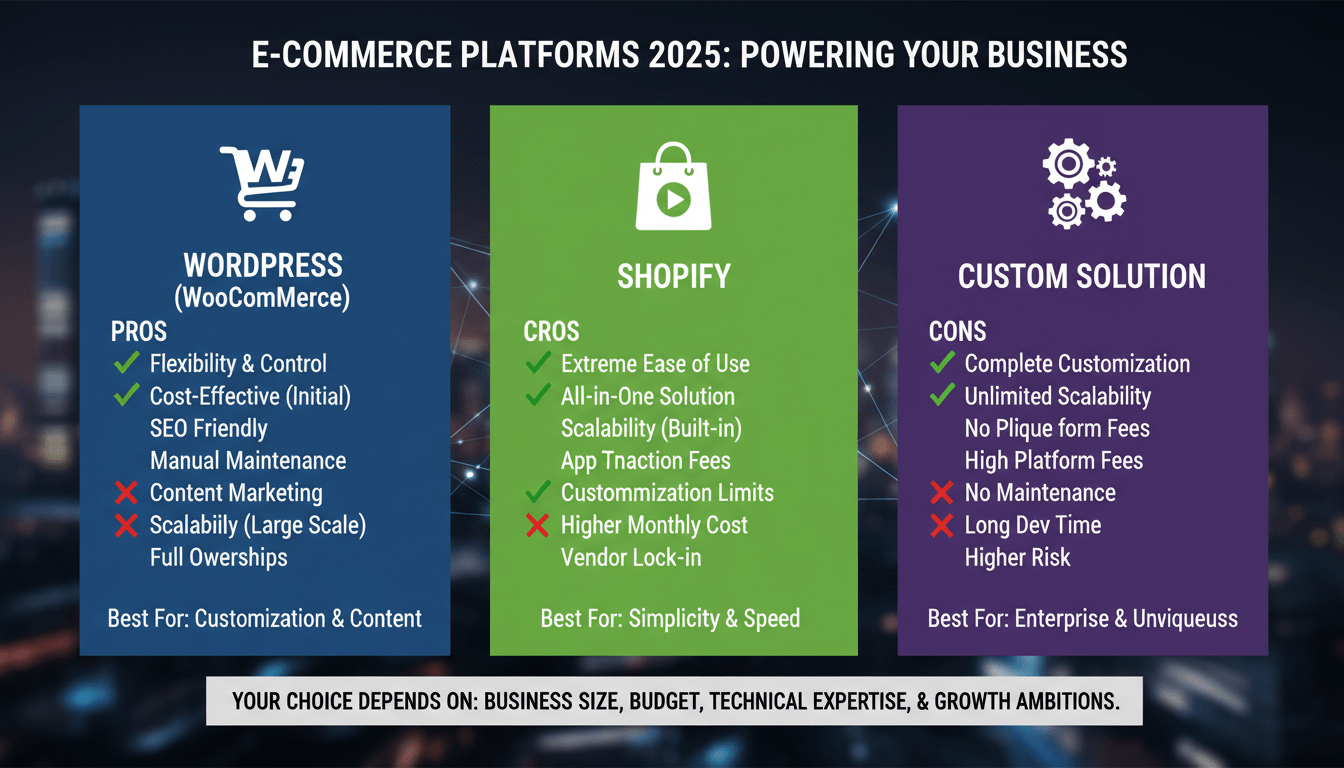
WordPress vs. Shopify vs. Custom: Which Platform Is Right for Your Business in 2025?

In 2025, having a high-performing, scalable website is no longer optional—it’s a core part of your business strategy. However, before you even begin designing your website, one critical decision needs to be made: which website platform in 2025 is right for you—WordPress, Shopify, or a fully custom-built solution?

To make an informed decision, let’s break down the pros and cons of each to help you choose the best fit.

How to Choose the Best Website Platform in 2025

Let’s start with WordPress: Flexibility at Scale

Ideal for blogs, service-based businesses, content-heavy websites, scalable corporate sites.

✅ Pros:

  • Highly customizable with thousands of themes and plugins.
  • Ideal for SEO and content marketing.
  • Great for hybrid sites (e.g., service + blog + eCommerce with WooCommerce).
  • Open-source and developer-friendly.
  • Strong community support.

❌ Cons:

  • Requires regular updates and maintenance.
  • Plugin bloat can hurt performance if not optimized.
  • Not built specifically for eCommerce (you’ll need WooCommerce).

Despite these drawbacks, WordPress remains a top contender as a website platform in 2025 for businesses looking for content flexibility and SEO dominance.

Tip from ZeroRadius:

We use custom themes and lightweight plugin stacks to keep your WordPress site blazing fast and easy to manage.

Is Shopify the Right Website Platform in 2025?

Next, let’s explore Shopify: eCommerce Made Simple

Specifically suited for online stores, dropshipping, D2C brands, inventory-heavy businesses.

✅ Pros:

  • All-in-one eCommerce platform with hosting, security, and updates built-in.
  • Fast setup with minimal technical knowledge.
  • Secure, reliable, and optimized for sales.
  • Excellent app ecosystem for payments, shipping, inventory, and marketing.

❌ Cons:

  • Limited design flexibility without code customization.
  • Monthly fees and extra costs for premium apps.
  • SEO and blog capabilities not as strong as WordPress.

If your focus is online retail, Shopify may be the most streamlined website platform for 2025, especially for startups and D2C brands.

Tip from ZeroRadius:

We optimize Shopify stores for mobile conversions, speed, and custom branding while keeping the backend clean and easy to manage.

When to Choose a Custom Website Platform in 2025

Finally, Custom Development: Full Control, Zero Limits

Best for SaaS platforms, web apps, large-scale enterprise websites, unique user experiences.

✅ Pros:

  • Tailored to your exact business logic, workflow, and design needs.
  • No third-party plugin or theme limitations.
  • Better long-term scalability and security.
  • Built for performance from the ground up.

❌ Cons:

  • Higher initial cost and longer development time.
  • Requires experienced developers for maintenance.
  • Not ideal for MVPs or small-budget projects.

Still unsure which website platform in 2025 aligns with your business model and goals? Our team at ZeroRadius can help you evaluate every option.

Tip from ZeroRadius:

We reserve custom builds for businesses with complex needs or when off-the-shelf solutions become limiting.

Website Platform 2025 Comparison Snapshot

Feature WordPress Shopify Custom Development
Speed & Performance ★★★☆☆ (Needs tuning) ★★★★☆ (Optimized) ★★★★★ (Fully controlled)
SEO & Blogging ★★★★★ ★★☆☆☆ ★★★★☆
eCommerce Capabilities ★★★★☆ (with plugins) ★★★★★ ★★★★☆ (Customizable)
Customization ★★★★☆ ★★☆☆☆ ★★★★★
Time to Launch ★★★☆☆ ★★★★★ ★★☆☆☆
Maintenance ★★☆☆☆ ★★★★★ ★★☆☆☆
Cost $–$$ $$–$$$ $$$–$$$$

Final Thoughts: Choosing the Right Website Platform in 2025

Ultimately, there’s no one-size-fits-all answer. The best platform is the one that aligns with your business goals, budget, and long-term vision.

  • To summarize, choose WordPress if you want flexibility and control.
  • Choose Shopify if your main focus is selling products online with ease.
  • Choose Custom Development if you need complete control over the experience and functionality.

At ZeroRadius, we specialize in WordPress, WooCommerce, Shopify, BigCommerce, and fully custom solutions—so no matter where you are in your journey, we’ll help you choose and build the right platform for growth.

Need help deciding the best platform for your business?


👉 Let’s Talk – Get a Free Consultation

🤔 Frequently Asked Questions (FAQs)

Yes, it is. WordPress remains popular due to its flexibility and plugins. As a result, it’s still a top choice for business websites.

If you need a quick and easy eCommerce setup, then Shopify is better. Unlike WordPress, it comes ready with tools for selling online.

Although it costs more, a custom site gives you full control and better performance. So, it’s ideal for long-term growth.

Yes, you can. However, migration takes effort and time. That’s why picking the right platform early is smart.

WordPress, with plugins like Yoast, offers more SEO control. Even so, Shopify also has decent built-in SEO tools.

Yes, it is. WordPress remains popular due to its flexibility and plugins. As a result, it’s still a top choice for business websites.If you need a quick and easy eCommerce setup, then Shopify is better. Unlike WordPress, it comes ready with tools for selling online.Although it costs more, a custom site gives you full control and better performance. So, it’s ideal for long-term growth.Yes, you can. However, migration takes effort and time. That’s why picking the right platform early is smart.WordPress, with plugins like Yoast, offers more SEO control. Even so, Shopify also has decent built-in SEO tools.