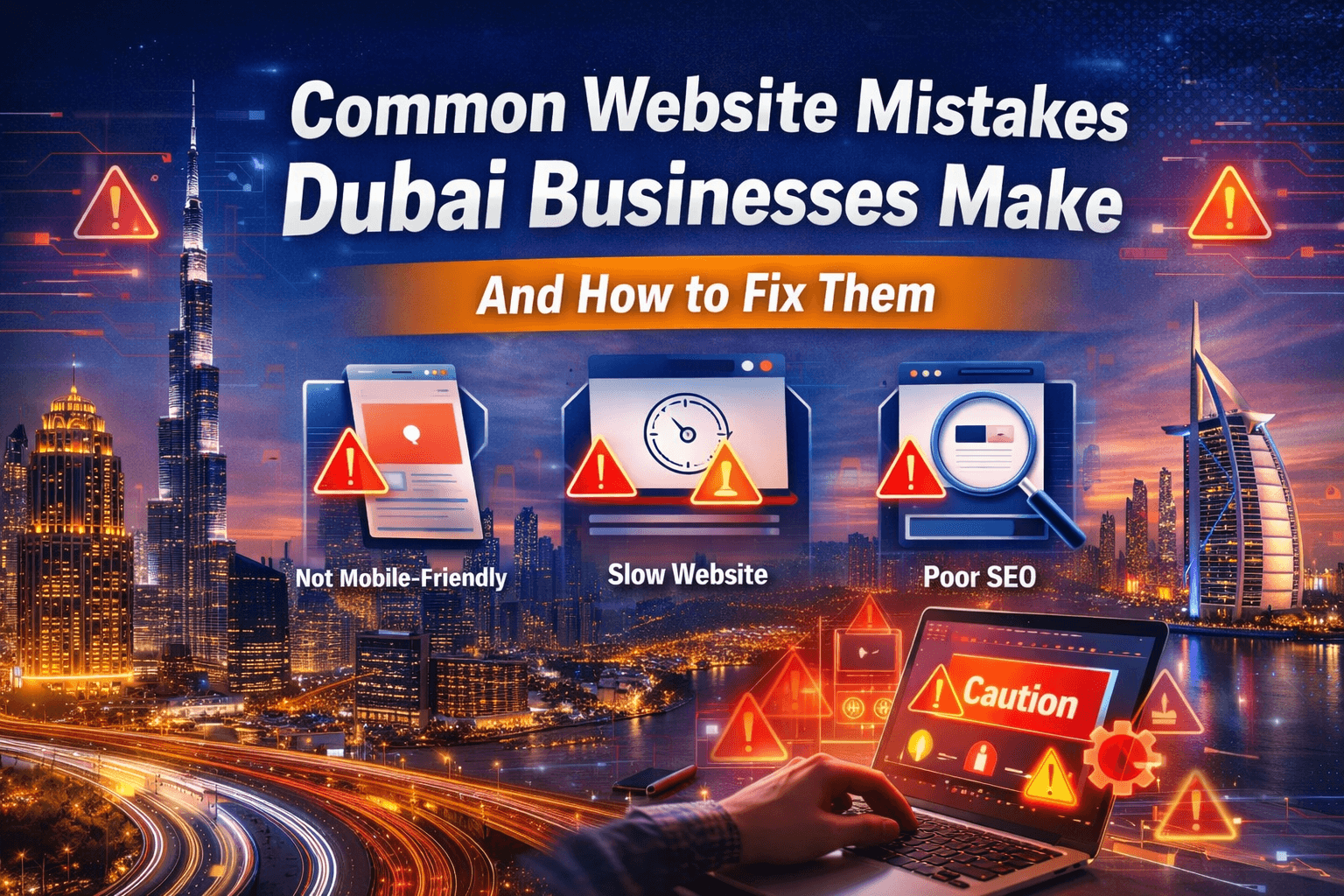
Common Website Mistakes Dubai Businesses Make (And How to Fix Them)

Introduction

Many Dubai businesses invest in website development but fail to generate leads, traffic, or conversions. In a competitive market like Dubai, even small website mistakes can reduce search rankings and impact brand credibility.

From poor mobile optimization to weak SEO strategies, these common website mistakes in Dubai can silently cost businesses thousands of dirhams in lost opportunities.

Let’s explore the most critical website mistakes Dubai businesses make — and how to fix them effectively.

Ignoring Mobile-First Design

Dubai has one of the highest smartphone usage rates in the world. Yet many business websites are still designed primarily for desktop users.

Why This Is a Problem:

  • Poor mobile experience increases bounce rate
  • Google prioritizes mobile-first indexing
  • Customers abandon slow or hard-to-navigate websites

How to Fix It:

  • Implement responsive web design
  • Optimize images and buttons for mobile
  • Use fast-loading mobile frameworks


Tip from Zeroradius:

Always test your website on multiple mobile devices and screen sizes before launch. A mobile-optimized website in Dubai significantly improves both SEO rankings and conversion rates.

Slow Website Speed & Poor Performance

Website speed directly affects SEO and user trust. In Dubai’s fast-paced business environment, users expect instant loading.

Common Performance Issues:

  • Heavy images
  • Poor hosting
  • Unoptimized code
  • No caching or CDN

How to Fix It:

  • Compress images using next-gen formats
  • Use UAE-based or global CDN hosting
  • Minify CSS and JavaScript
  • Monitor Core Web Vitals


Tip from Zeroradius:

Deploy your website on high-performance cloud hosting with CDN support across the GCC to maintain consistent speed and stability.

Weak Local SEO Strategy

Many Dubai businesses build websites without optimizing for local search visibility.

Mistakes Include:

  • Not targeting “Dubai” in keywords
  • No Google Business Profile optimization
  • Missing location-based landing pages

How to Fix It:

  • Include geo-targeted keywords like “web development company in Dubai”
  • Optimize meta titles and descriptions
  • Create service pages for areas like Business Bay, Dubai Marina, JLT


Tip from Zeroradius:

Add structured data (schema markup) and location-specific FAQs to improve your chances of ranking in Google UAE search results.

No Clear Call-to-Action (CTA)

A website without a clear CTA confuses visitors. Many Dubai business websites lack visible contact buttons, inquiry forms, or booking options.

Why This Hurts:

  • Visitors don’t know what action to take
  • Lower lead generation
  • Reduced ROI

How to Fix It:

  • Place clear CTAs above the fold
  • Use action-driven language
  • Add WhatsApp and click-to-call buttons


Tip from Zeroradius:

In Dubai’s competitive market, strong CTAs like “Get a Free Consultation in Dubai” perform better than generic “Contact Us” buttons.

Outdated Website Design

Dubai is known for innovation and luxury. An outdated website damages credibility instantly.

Common Issues:

  • Old layouts
  • Cluttered design
  • Poor typography
  • Inconsistent branding

How to Fix It:

  • Upgrade to modern UI/UX standards
  • Use clean layouts with strong visuals
  • Ensure brand consistency


Tip from Zeroradius:

Refresh your website design every 2–3 years to stay aligned with evolving digital expectations in Dubai.

Not Using Analytics & Tracking

Many businesses launch websites without tracking performance.

What Happens:

  • No visibility into user behavior
  • No data-driven decisions
  • Missed optimization opportunities

How to Fix It:

  • Install Google Analytics
  • Set up conversion tracking
  • Monitor traffic sources


Tip from Zeroradius:

Track which pages generate leads in Dubai and optimize those pages further with stronger CTAs and local SEO keywords.

Poor Content Strategy

Some Dubai websites rely only on basic service pages and never publish blog content.

Why This Is a Mistake:

  • Limited keyword reach
  • No authority building
  • Lower search visibility

How to Fix It:

  • Create location-focused blog posts
  • Publish industry guides
  • Add FAQs targeting Dubai searches


Tip from Zeroradius:

Build a content cluster around “Website Development in Dubai” to improve topical authority and rank faster in competitive keywords.

🤔 Frequently Asked Questions (FAQs)

The biggest website mistake Dubai businesses make is ignoring mobile optimization and local SEO. Without these elements, websites struggle to rank in Google UAE and fail to convert mobile users effectively.

To improve website ranking in Dubai, focus on local SEO, optimize website speed, create high-quality content, and use geo-targeted keywords. Performance optimization and strong CTAs also help increase engagement and conversions.

Yes, website speed directly impacts Google rankings and user experience in Dubai. Faster websites reduce bounce rates and improve Core Web Vitals scores, which are key ranking factors.

Dubai businesses should consider redesigning their websites every 2–3 years to stay aligned with modern design trends, performance standards, and evolving user expectations.

The biggest website mistake Dubai businesses make is ignoring mobile optimization and local SEO. Without these elements, websites struggle to rank in Google UAE and fail to convert mobile users effectively.To improve website ranking in Dubai, focus on local SEO, optimize website speed, create high-quality content, and use geo-targeted keywords. Performance optimization and strong CTAs also help increase engagement and conversions.Yes, website speed directly impacts Google rankings and user experience in Dubai. Faster websites reduce bounce rates and improve Core Web Vitals scores, which are key ranking factors.Dubai businesses should consider redesigning their websites every 2–3 years to stay aligned with modern design trends, performance standards, and evolving user expectations.

How Dubai Businesses Can Stay Ahead in 2026

In a competitive digital market like Dubai, avoiding common website mistakes is critical for business growth. From mobile optimization and performance enhancement to local SEO and conversion-focused design, every detail impacts your online success.

Businesses that proactively fix these website mistakes can significantly improve their search rankings, lead generation, and overall digital presence in Dubai.
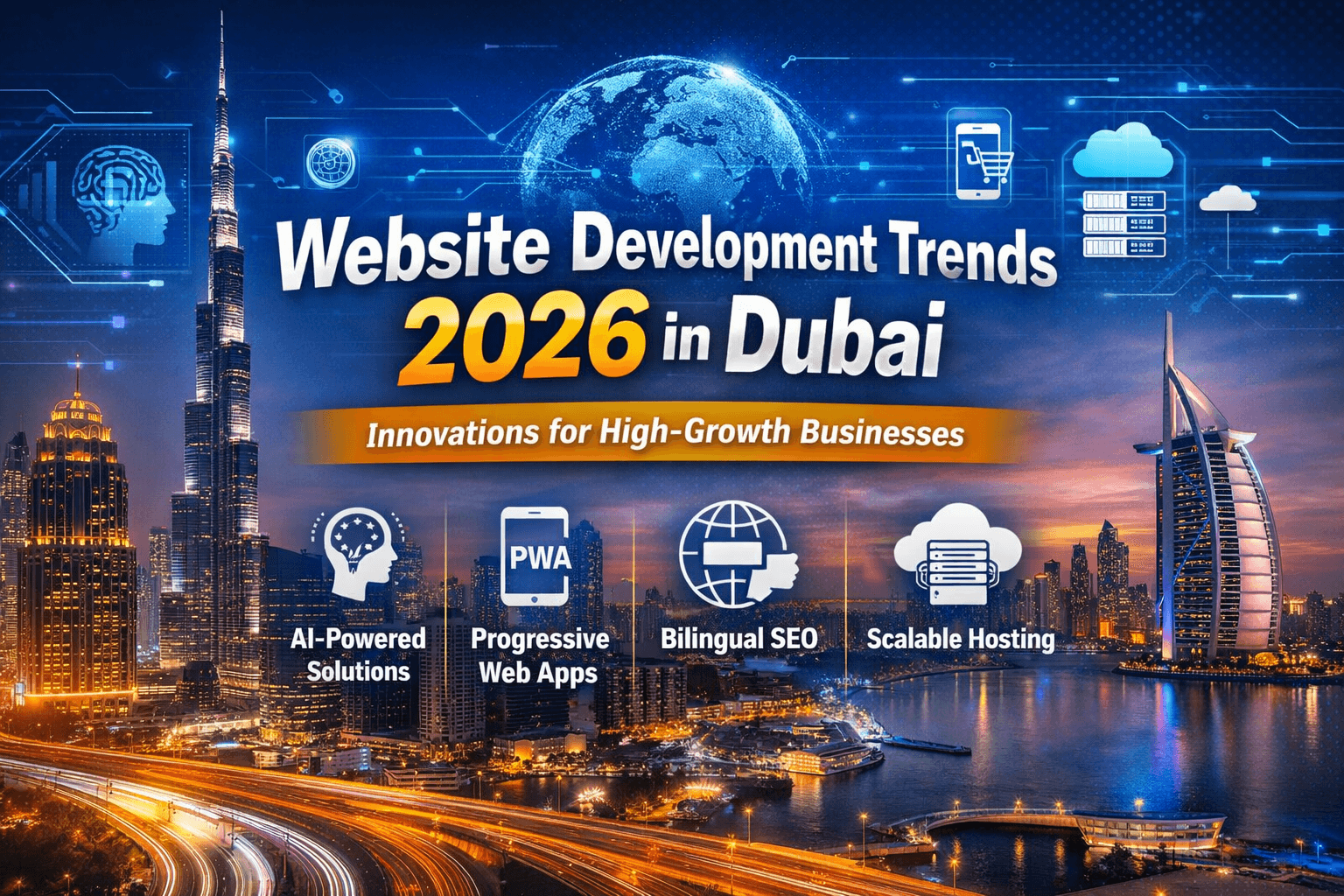
Website Development Trends 2026 in Dubai: What Smart Businesses Must Implement Now

Executive Summary: The Future of Website Development in Dubai

In 2026, website development trends in Dubai are centered around AI-driven personalization, high-performance architecture, bilingual optimization (English & Arabic), Progressive Web Apps, headless CMS systems, and scalable cloud infrastructure. Businesses implementing these innovations are achieving higher search rankings, stronger lead generation, and better digital ROI in Dubai’s competitive market.
Dubai companies can no longer rely on basic website design. Performance, intelligence, and user experience now define digital success.

Why Website Development in Dubai Is Evolving Rapidly

Dubai is one of the most digitally competitive markets in the Middle East. Industries such as:

  • Real Estate
  • Hospitality
  • Luxury Retail
  • eCommerce
  • Corporate & Financial Services

are heavily investing in digital transformation.

Because of this:

  • Users expect ultra-fast load speeds
  • Mobile-first experiences are mandatory
  • Multilingual accessibility is critical
  • AI-powered personalization is becoming standard
  • Modern website development in Dubai must align with these expectations.

AI Web Development in Dubai: The Personalization Revolution

AI-powered web development is transforming how Dubai businesses engage visitors. Instead of showing the same homepage to everyone, intelligent websites now:

  • Display location-based content
  • Adjust service offerings dynamically
  • Customize CTAs based on behavior
  • Recommend products using predictive analytics

For example, a real estate website in Dubai can show Downtown properties to users browsing from that region.

Business Impact in Dubai:

  • Higher lead conversion rates
  • Reduced bounce rates
  • Increased time on site
  • Stronger customer engagement


Tip from Zeroradius:

Use AI personalization engines to automatically tailor landing pages based on user location (Dubai Marina, Business Bay, Jumeirah) and traffic source, increasing relevance and conversion probability.

Mobile-First & Progressive Web Apps (PWAs) in Dubai

Dubai has one of the highest smartphone penetration rates globally. A desktop-only optimized website will lose traffic.

Progressive Web Apps provide:

  • Instant loading
  • Offline browsing capability
  • App-style navigation
  • Push notification marketing

For eCommerce brands in Dubai, PWAs significantly improve cart completion rates.

Why PWAs Work in Dubai:

  • Fast mobile browsing culture
  • Heavy reliance on smartphone transactions
  • High competition requiring better UX


Tip from Zeroradius:

Convert high-converting landing pages and product catalogs into lightweight PWAs to boost mobile engagement without compromising SEO visibility.

Website Performance Optimization & Core Web Vitals

Speed is a ranking factor and a revenue factor.

Dubai users expect instant loading. A delay of even 2–3 seconds can reduce conversions significantly.

Performance priorities in 2026:

  • Optimized Largest Contentful Paint (LCP)
  • Reduced Interaction to Next Paint (INP)
  • Stable layout structure (CLS)
  • Image compression using next-gen formats
  • Clean code architecture

Why It Matters in Dubai:

Competitive industries like real estate and luxury retail cannot afford slow websites.


Tip from Zeroradius:

Deploy your website on high-performance UAE-optimized hosting with integrated CDN distribution across the GCC to maintain consistent speed.

Headless CMS & Scalable Architecture for Growing Brands

As Dubai companies expand regionally, they need scalable digital infrastructure.

Headless CMS offers:

  • Faster front-end performance
  • API-based integrations
  • Omnichannel publishing
  • Flexibility for multi-language websites

This is ideal for brands targeting both UAE and international markets.


Tip from Zeroradius:

Adopt API-first headless architecture to seamlessly integrate CRM, ERP, marketing automation, and bilingual content delivery without slowing performance.

Bilingual SEO & Arabic Optimization

Dubai’s diverse population requires English and Arabic optimization.

A bilingual website improves:

  • Local trust
  • Search visibility
  • Conversion rates
  • Brand credibility

Arabic SEO requires:

  • Right-to-left layout compatibility
  • Proper keyword research
  • Structured content
  • Schema markup


Tip from Zeroradius:

Create separate optimized Arabic landing pages instead of automated translations to maximize search performance and cultural relevance.

Voice Search Optimization in Dubai

Voice search is increasing due to smart devices and mobile assistants.

To optimize:

  • Use conversational keyword phrases
  • Create FAQ-based content
  • Implement structured data
  • Target long-tail location-based queries

Example:
“Best web development company in Dubai Marina”


Tip from Zeroradius:

Develop location-based FAQ sections to capture conversational and voice-based search traffic in Dubai.

Cloud-Native & Serverless Infrastructure

Serverless architecture ensures your website scales automatically during:

  • Seasonal campaigns
  • Real estate launches
  • Event promotions
  • eCommerce sales

Advantages include:

  • Automatic scaling
  • Lower operational complexity
  • Better uptime
  • Faster global performance


Tip from Zeroradius:

Use serverless cloud infrastructure combined with edge computing to maintain performance during high-traffic periods in Dubai.

Industry-Specific Website Development Trends in Dubai

Real Estate

  • AI-powered property filtering
  • Virtual tours & interactive maps
  • Fast listing search systems

eCommerce

  • Personalized product recommendations
  • Mobile-first checkout
  • PWA-based shopping experiences

Hospitality

  • AI booking assistants
  • Multilingual booking pages
  • Performance-optimized reservation systems

🤔 Frequently Asked Questions (FAQs)

The biggest trend in 2026 is AI-powered marketing automation combined with hyper-personalization. Brands are using AI to optimize campaigns, predict customer behavior, and deliver real-time personalized experiences.

AI is important for websites in Dubai because it improves user experience through real-time personalization, chatbot automation, and predictive product recommendations. In a highly competitive market like Dubai, AI-driven websites help businesses increase engagement, conversions, and customer retention.

Website development cost in Dubai in 2026 typically ranges from AED 5,000 for basic business websites to AED 40,000+ for advanced eCommerce or custom AI-powered platforms. The final cost depends on features, integrations, performance requirements, and scalability needs.

For many Dubai businesses, Progressive Web Apps (PWAs) are more cost-effective than native mobile apps. PWAs offer fast loading speeds, offline functionality, and app-like experiences without requiring users to download from app stores.

Website speed is a major ranking factor in Google UAE search results. Faster websites reduce bounce rates, improve user experience, and increase conversions — especially important in Dubai’s competitive industries like real estate, tourism, and eCommerce.

The biggest trend in 2026 is AI-powered marketing automation combined with hyper-personalization. Brands are using AI to optimize campaigns, predict customer behavior, and deliver real-time personalized experiences.

AI is important for websites in Dubai because it improves user experience through real-time personalization, chatbot automation, and predictive product recommendations. In a highly competitive market like Dubai, AI-driven websites help businesses increase engagement, conversions, and customer retention.Website development cost in Dubai in 2026 typically ranges from AED 5,000 for basic business websites to AED 40,000+ for advanced eCommerce or custom AI-powered platforms. The final cost depends on features, integrations, performance requirements, and scalability needs.For many Dubai businesses, Progressive Web Apps (PWAs) are more cost-effective than native mobile apps. PWAs offer fast loading speeds, offline functionality, and app-like experiences without requiring users to download from app stores.Website speed is a major ranking factor in Google UAE search results. Faster websites reduce bounce rates, improve user experience, and increase conversions — especially important in Dubai’s competitive industries like real estate, tourism, and eCommerce.

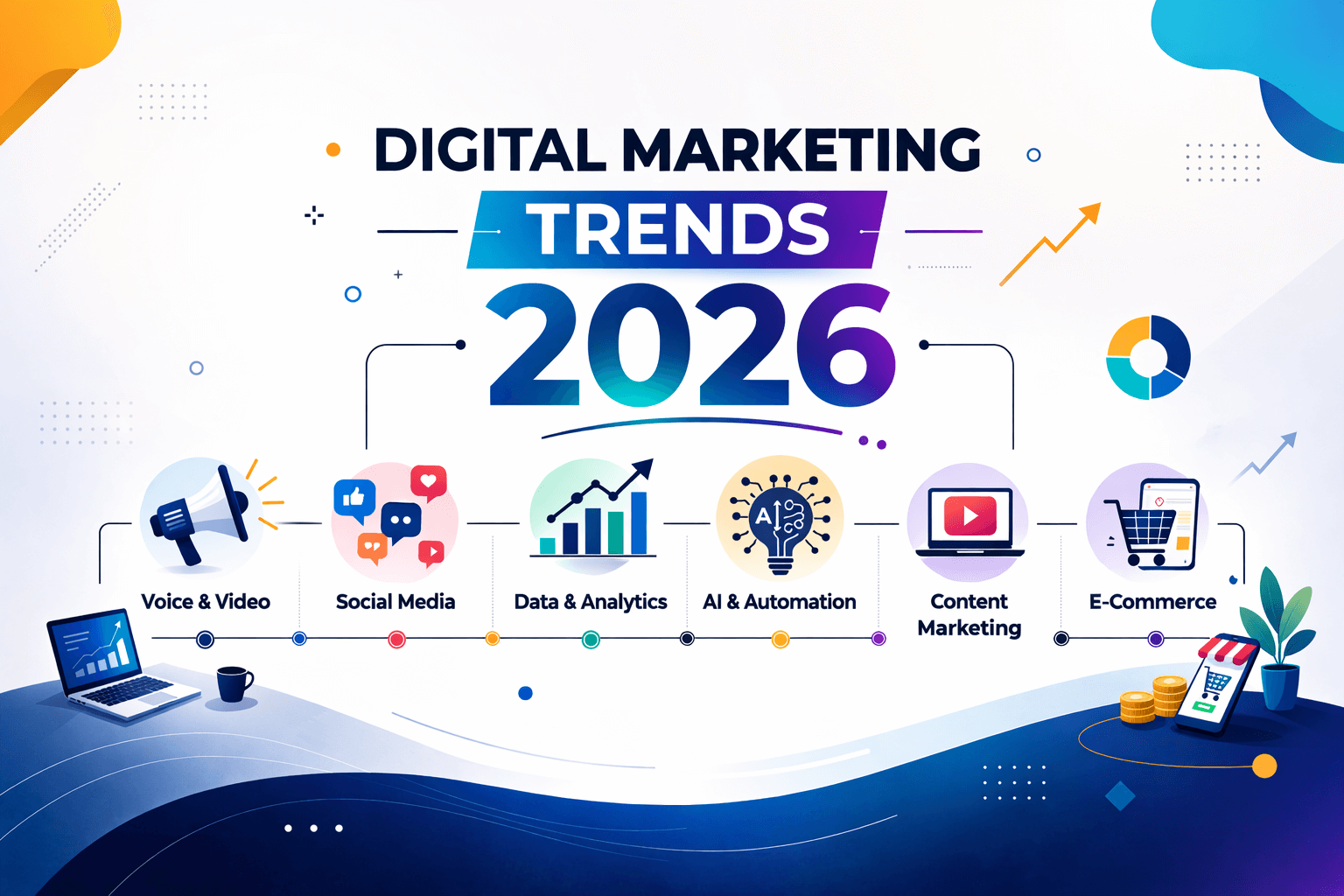
Digital Marketing Trends 2026: How to Win in the Next Era of Intelligent Engagement

Digital Marketing Is Entering Its Smartest Era

Digital marketing in 2026 is no longer about simply running ads or ranking on Google. It’s about AI-driven personalization, zero-click search visibility, privacy-first data strategies, and real-time engagement ecosystems.

Customers expect:

  • Instant answers
  • Personalized experiences
  • Seamless omnichannel journeys
  • Authentic brand communication

Brands that adapt to these shifts will dominate. Those that rely on outdated tactics will struggle to stay visible.

Let’s explore the most important digital marketing trends shaping 2026 — and how you can use them to grow.

AI-Powered Marketing Becomes the Core Strategy

AI is no longer just a tool — it’s the backbone of digital marketing operations.

What’s Changing in 2026?

  • AI-driven campaign automation
  • Predictive customer journey mapping
  • Real-time budget optimization
  • Generative AI content production
  • AI-powered CRO (Conversion Rate Optimization)

AI systems now analyze behavior patterns and automatically adjust creatives, targeting, and bidding strategies.


Tip from Zeroradius:

Integrate AI into your core marketing stack (CRM, email automation, paid ads, content production).

Search Becomes Conversational & Zero-Click

Traditional SEO is evolving.

Search engines and AI assistants now provide direct answers without users clicking through websites. This is called Zero-Click Search.

What Matters Now?

  • Answer Engine Optimization (AEO)
  • Structured data (Schema markup)
  • FAQ-based content
  • Conversational keyword targeting
  • Featured snippet optimization


Tip from Zeroradius:

Structure your blog posts with clear headings, concise answers, and FAQ sections to rank in AI Overviews.

Hyper-Personalization at Scale

Mass marketing is dead.

In 2026, brands use:

  • Behavioral data
  • Purchase history
  • Real-time engagement signals
  • Predictive analytics

This allows fully personalized product recommendations, email flows, landing pages, and ad creatives.


Tip from Zeroradius:

Use first-party data and AI segmentation to deliver 1:1 experiences.

Short-Form Video Dominates Conversions

Short-form video is no longer just for awareness — it’s a conversion engine.

Platforms leading this shift:

  • TikTok
  • Instagram Reels
  • YouTube Shorts
  • LinkedIn vertical video

Why It Works

  • Higher engagement rates
  • Faster trust building
  • Direct in-app shopping integration


Tip from Zeroradius:

Build a weekly short-form video content strategy aligned with your sales funnel.

First-Party Data & Privacy-First Marketing

With third-party cookies disappearing, brands must rely on:

  • Email marketing
  • Loyalty programs
  • Interactive content
  • Community building
  • CRM integration
  • Consumers reward transparency.


Tip from Zeroradius:

Create value-driven lead magnets and build strong email ecosystems.

Social Commerce Becomes a Full Funnel

Social media platforms now support:

  • In-app checkout
  • Live shopping
  • Influencer storefronts
  • Community-driven selling

Social platforms are now search engines, marketplaces, and engagement hubs.


Tip from Zeroradius:

Treat social media as a revenue channel, not just branding.

Authenticity Beats Automation

While AI is powerful, human storytelling wins loyalty.

Brands that:

  • Show real people
  • Share behind-the-scenes content
  • Focus on community engagement
  • Create emotional storytelling

… will build long-term trust.


Tip from Zeroradius:

Balance automation with authentic brand voice.

How to Prepare Your Business for Digital Marketing in 2026

Here’s a practical roadmap:

✔ Adopt AI-powered tools
✔ Optimize for zero-click search
✔ Invest in short-form video
✔ Build first-party data assets
✔ Focus on personalized journeys
✔ Strengthen brand authenticity

🤔 Frequently Asked Questions (FAQs)

The biggest trend in 2026 is AI-powered marketing automation combined with hyper-personalization. Brands are using AI to optimize campaigns, predict customer behavior, and deliver real-time personalized experiences.

Yes, SEO is evolving rather than disappearing. In 2026, success depends on conversational search optimization, structured data, and Answer Engine Optimization (AEO) to appear in AI-generated results and featured snippets.

AI is transforming digital marketing through automated content creation, predictive analytics, real-time campaign optimization, chatbots, and personalized customer journeys.

Short-form video is one of the most powerful marketing tools in 2026. It drives engagement, builds trust quickly, and integrates directly with social commerce features for instant conversions.

First-party data is critical because third-party cookies are being phased out. Brands must collect and use customer data ethically to personalize experiences and maintain compliance with privacy regulations.

The biggest trend in 2026 is AI-powered marketing automation combined with hyper-personalization. Brands are using AI to optimize campaigns, predict customer behavior, and deliver real-time personalized experiences.Yes, SEO is evolving rather than disappearing. In 2026, success depends on conversational search optimization, structured data, and Answer Engine Optimization (AEO) to appear in AI-generated results and featured snippets.AI is transforming digital marketing through automated content creation, predictive analytics, real-time campaign optimization, chatbots, and personalized customer journeys.Short-form video is one of the most powerful marketing tools in 2026. It drives engagement, builds trust quickly, and integrates directly with social commerce features for instant conversions.First-party data is critical because third-party cookies are being phased out. Brands must collect and use customer data ethically to personalize experiences and maintain compliance with privacy regulations.

AI + Shopify Trends 2026: How to Thrive in the Next Era of Smart Commerce

Artificial intelligence has transformed eCommerce — and 2026 marks the year when AI is no longer just a tool, but the engine powering every smart Shopify store. From personalized shopping journeys and automation to advanced shop optimization and predictive commerce, AI is redefining how merchants attract, convert, and retain customers.

In this article, we’ll explore the top AI trends shaping Shopify in 2026 and show you how your business can leverage them to stay competitive and thrive in the AI era.

Hyper-Personalization Becomes the Default Standard

In 2026, generic experiences simply don’t convert.

AI now analyzes real-time behavior, purchase history, and search patterns to serve dynamic content tailored to each visitor. This goes beyond product recommendations — it includes personalized navigation, landing pages, and checkout experiences.

How it Works:

  • AI segments visitors instantly and adapts product feeds accordingly
  • Real-time personalization boosts conversions and average order values
  • Personalized discounts and offers increase retention


Tip from Zeroradius:

Use Shopify AI and third-party personalization apps to tailor category pages and homepage content for each user segment.

Autonomous AI Shopping Agents Rise

In 2026, customers don’t just browse — AI shopping agents do shopping on their behalf. These intelligent agents can search products, compare prices, filter reviews, and complete purchases.

This shift changes the way merchants must present products:

👉 Product data must be clean, structured, and AI-readable
👉 Voice and natural language search rankings become essential


Tip from Zeroradius:

Optimize product titles and descriptions with structured schema to ensure they are easily discoverable by AI agents.

AI-Powered Visual & Voice Commerce

As visual shopping and voice search grow, AI helps Shopify stores convert these interactions into revenue.

Key shifts include:

  • Visual Search: Customers upload images to find matching products instantly
  • Voice Commerce: Conversational purchasing via smart speakers and voice assistants grows


Tip from Zeroradius:

Add visual search capabilities to your shop, and optimize product content for natural language queries.

Predictive Analytics & Demand Forecasting

AI doesn’t just report what happened — it predicts what will happen next.

Leading Shopify brands in 2026 use AI to:

  • Forecast demand by SKU and region
  • Predict reorder cycles
  • Identify trending products before they peak
  • Reduce stockouts and excess inventory


Tip from Zeroradius:

Use predictive forecasting tools to automate stock planning and avoid supply chain bottlenecks.

Advanced Dynamic Pricing

Pricing in 2026 is driven by intelligence, not intuition.

AI pricing engines adjust prices in real time based on:

  • Competitor pricing
  • Supply and demand
  • Visitor profiles
  • Buying signals

This helps merchants optimize margins while staying competitive.


Tip from Zeroradius:

Implement AI dynamic pricing tools that allow rule-based pricing with guardrails to protect profitability.

Conversational Commerce & Smart Support

Modern AI assistants don’t just answer questions — they sell.
AI chatbots on Shopify now:

  • Guide shoppers through product discovery
  • Recommend bundles and add-ons
  • Complete purchases inside chat
  • Recover carts through conversational prompts


Tip from Zeroradius:

Choose AI bots trained on your catalog — not generic ones — to increase conversion rates from support channels.

Immersive Shopping with AR + AI

Augmented Reality paired with AI personalized previews helps shoppers visualize products more accurately — boosting confidence and reducing returns.

Today’s AI tools automatically:

  • Customize AR previews per user (size, color, context)
  • Integrate virtual try-ons for fashion and accessories


Tip from Zeroradius:

Integrate AR previews on product pages, especially for categories with high return rates.

AI-Driven SEO (Optimizing for the AI Search Era)

Search engines and AI retrieval systems are evolving fast — and Shopify stores must adapt.

In 2026, optimization focuses on:

  • Semantic search and entity signals

  • Structured data (AI retrieval optimized)

  • Conversational query optimization

  • Real-world answer surfaces beyond SERPs


Tip from Zeroradius:

Use topic clusters, long-form insights, structured schema, and AI-friendly content to rank in both traditional and AI-powered search.

Automated Store Optimization

AI isn’t just augmenting tasks — it’s automating them.

In 2026, smart Shopify stores:

  • Self-test UX elements (headlines, layouts, UX flows)
  • Adjust checkout funnels dynamically
  • Optimize pricing thresholds learning from customer behavior

AI doesn’t just collect data — it acts on it without human input.


Tip from Zeroradius:

Enable auto-optimization features in store analytics tools and review insights monthly.

Ethical AI & Trust as a Competitive Advantage

Advanced AI raises new responsibilities.

Successful Shopify brands in 2026 prioritize:
Transparent data practices

  • Customer consent and privacy controls
  • Ethical personalization (no dark patterns)
  • Secure checkout and fraud detection
  • Clarity around AI-generated recommendations

Trust becomes a differentiator in a crowded marketplace.


Tip from Zeroradius:

Publish clear AI and data usage policies and offer customers easy opt-out personalization controls.

Conclusion

AI in 2026 is no longer a “nice-to-have” — it’s a strategic necessity for Shopify success. From predictive analytics to autonomous shopping agents, immersive experiences to dynamic pricing, the merchants who win in the AI era are the ones embracing innovation at every level.

AI isn’t just a tool — it’s your competitive edge.

🤔 Frequently Asked Questions (FAQs)

AI is turning Shopify stores into intelligent commerce engines with automated personalization, predictive growth, and conversion-focused optimization.

AI-native stores, shopping agents, predictive forecasting, conversational commerce, and AI-driven SEO are leading trends.

It means structuring your Shopify store so AI assistants can easily discover, understand, and recommend your products.

Yes, many scalable AI tools and WP plugins make implementation accessible without large upfront costs.

Yes, when set with margin controls, it adjusts prices intelligently without harming profitability.

AI is turning Shopify stores into intelligent commerce engines with automated personalization, predictive growth, and conversion-focused optimization.

AI-native stores, shopping agents, predictive forecasting, conversational commerce, and AI-driven SEO are leading trends.

It means structuring your Shopify store so AI assistants can easily discover, understand, and recommend your products.

Yes, many scalable AI tools and WP plugins make implementation accessible without large upfront costs.

Yes, when set with margin controls, it adjusts prices intelligently without harming profitability.

AI Mastering E-Commerce in the AI Era (2025 & Beyond)

The e-commerce landscape is no longer just about great products — it’s about smart, AI-driven experiences that delight customers before they even click “Add to Cart.” In 2025, AI isn’t optional — it’s the backbone of growth.

Here’s what’s trending — and how WordPress + AI can help you win:

Hyper-Personalization Becomes the Norm

AI analyzes buyer behavior — browsing patterns, purchase history, even current context — to serve customized recommendations, search results, and dynamic content.

Result: Better engagement, higher conversions, and deeper loyalty.


Tip from Zeroradius:

Integrate AI-powered product recommendations & personalized blocks using plugins that support machine learning insights.

Conversational Commerce & Smart Assistance

Forget static support pages — AI chatbots and virtual assistants now handle real conversations:

✔ Answer FAQs
✔ Recommend products
✔ Track orders
✔ Execute voice & natural language queries

All without human handoffs.


Tip from Zeroradius:

Use AI chatbot plugins to automate 24/7 support directly on your store.

AI-Optimized Backend Powers Scale

AI isn’t just about UX — it’s about operations too:

  • Predictive inventory forecasting
  • Dynamic pricing
  • Fraud and return mitigation
  • Faster fulfillment

This cuts costs while improving reliability.


Tip from Zeroradius:

Connect analytics & AI plugins to your WooCommerce store for smarter backend decision-making.

Visual & Voice Search Drives Discovery

Customers are increasingly shopping with images and voice commands — and AI now understands them.

    • Upload a photo to find matching products.
    • Ask your digital assistant “find this item” and get instant results.


Tip from Zeroradius:

Enable visual/voice search plugins to turn browsing into an interactive experience.

Agentic & AI-Driven Commerce

The future is agentic: autonomous AIs will soon shop on behalf of users — choosing products, comparing prices, and completing checkout.
To thrive in this new era:
👉 Structure your product data
👉 Provide rich metadata + schema
👉 Support API-ready endpoints so AI assistants can access your catalog

Key takeaway:

AI is not just a trend — it’s the operating system of modern online commerce. Whether you’re building on WordPress, WooCommerce, Shopify, or headless setups, embedding AI throughout your stack is the winning play for 2025 and beyond.

Want help implementing AI-optimized experiences in WordPress? Ask me how!

🤔 Frequently Asked Questions (FAQs)

AI enhances personalization, automates customer support, optimizes pricing, and improves inventory forecasting to boost conversions and efficiency.

Yes, WordPress and WooCommerce support AI through plugins and APIs for chatbots, recommendations, smart search, and analytics.

Hyper-personalization, conversational commerce, visual/voice search, dynamic pricing, and AI-driven automation are leading trends.

Yes, many scalable AI tools and WP plugins make implementation accessible without large upfront costs.

By structuring product data, using analytics, optimizing for AI search, and gradually integrating automation tools.

AI enhances personalization, automates customer support, optimizes pricing, and improves inventory forecasting to boost conversions and efficiency.Yes, WordPress and WooCommerce support AI through plugins and APIs for chatbots, recommendations, smart search, and analytics.Hyper-personalization, conversational commerce, visual/voice search, dynamic pricing, and AI-driven automation are leading trends.Yes, many scalable AI tools and WP plugins make implementation accessible without large upfront costs.By structuring product data, using analytics, optimizing for AI search, and gradually integrating automation tools.